
Nukh Berzegov


FamilyTreeDNA Branch R-BY63726:
https://discover.familytreedna.com/y-dna/R-BY63726/classic
https://discover.familytreedna.com/groups/circassian/tree?subgroups=252846
His family symbol is shown above.
Nukh Berzegov (Circassian: Бэрзэдж Iэслъэнчэрий и къуэ Нухь) was head of Adyghea from 1960 to 1983. The Adyghea was an autonomous region within Krasnodar Krai, Soviet Union and existed from 1922 to 1991.
Born on November 30, 1925 in Bzhedughabl (Бжъэдыгъухьабл) in Adyghea into a family of the descendants of the Ubykh aristocratic house of Berzeg (Ubykh: Барзагь).
He was brave, smart, and noble person. He was called up to the Eastern Front of WWII as a 17-year-old boy, rose through the military ranks up to regiment, and was awarded two Orders of the Red Star, the Order of the Patriotic War, 1st сlass, and seven other medals, including «For Courage». He became a Ph.D. in Economics in 1969.
He made significant efforts to develop the economy of Adygea, the remnant of historical Circassia, as well as to preserve the Circassian (Adyghe) people as an ethnic group. The years of Nukh Berzegov’s leadership of the Adygea, which lasted almost a quarter of a century, were one of the most fruitful periods in the development of its economy. After his career as the first secretary of Adyghea, he was Consul General of the USSR in Varna, Bulgaria. He was an honorary citizen of the Bulgarian cities of Ruse and Shumen. Nukh Berzegov lived a long and bright life leaving behind a notable legacy. He passed away on March 17, 2002. His detailed Y-DNA haplogroup was determined by Big Y testing of the grandson of his brother in the Circassian DNA Project.
Some links:
https://ru.wikipedia.org/wiki/%D0%91%D0%B5%D1%80%D0%B7%D0%B5%D0%B3%D0%BE%D0%B2,_%D0%9D%D1%83%D1%85_%D0%90%D1%81%D0%BB%D0%B0%D0%BD%D1%87%D0%B5%D1%80%D0%B8%D0%B5%D0%B2%D0%B8%D1%87
https://en.wikipedia.org/wiki/Adyghe_Autonomous_Oblast
https://en.wikipedia.org/wiki/Adyghe_Regional_Committee_of_the_Communist_Party_of_the_Soviet_Union
House of Inal

FamilyTreeDNA branch FT230654
Also, it’s possible that it’s FGC22480 too, an ancestor branch for FT230654.
https://discover.familytreedna.com/groups/circassian/tree?subgroups=252847
https://discover.familytreedna.com/y-dna/R-FT230654/classic
https://discover.familytreedna.com/y-dna/R-FGC22480/classic
House of Inal (Circassian: Инал Нэху) — was a dynastic lineage and noble families that claimed descent from Inal the Great, the legendary king of Circassia, revered for unifying the fragmented Circassian tribes into a consolidated state. Some historians date the time of his unification reforms to the 8th century, while others associate his activities with the 15th century. Inal is remembered not just as a king, but as a culture-bringer, lawgiver, and military genius. He is often mentioned in Circassian oral epics, genealogies, and historical chronicles as a founding patriarch.
Inal the Great was a pivotal figure in Circassian history and his legacy persists in the genealogies of noble families and the cultural memory of the Circassian people. He reportedly had many sons and grandsons, who became tribal princes and founders of several major Circassian tribes and noble houses. Those noble families in Kabarda were Misost (Circassian: Мысост), Atazhukin (Circassian: Хьэтохъущокъуэ), etc. Kabarda was the largest and easternmost tribal region of Circassia and Kabardians were known as politically and militarily the most powerful Circassian group. Ancient Kabardian legends convey to us the history of the foundation of Kabarda as a political entity, which began with a representative of the House of Tambiev. In the Middle Ages they ceded power to a new Inalid dynasty, who ruled Kabarda until its conquest by the Russian Empire in the 19th century.
The Cherkassky family that emerged from the Circassian nobility claims descent from Inal the Great, aligning themselves with his legacy of leadership and unification. Their ascent in Russian society began with strategic alliances and military service such as forged alliance with Tsar Ivan IV (Ivan the Terrible).
«Inalid Lineage» is sometimes used informally to describe families that trace noble descent back to his era thus not everyone who claims to be a descendant of him is one. The Y-DNA haplogroup was determined by Big Y testing of the representative of Misost family.
Some links:
https://en.wikipedia.org/wiki/Inal_the_Great
https://ru.wikipedia.org/wiki/%D0%98%D0%BD%D0%B0%D0%BB_(%D0%BA%D0%BD%D1%8F%D0%B7%D1%8C)
https://en.wikipedia.org/wiki/Temryuk_Idar
https://en.wikipedia.org/wiki/Kabardians
https://en.wikipedia.org/wiki/Cherkassky
https://commons.wikimedia.org/wiki/File:The_supreme_princes_of_the_Circassian_princedom_of_Kabarda.jpg
https://abkhazworld.com/aw/history/1724-the-legendary-circassian-prince-inal-by-vitaliy-shtybin

House of Tamby

FamilyTreeDNA branch R-FTB27706 / R-FT425089
Also possible to be up to FT343210 or even FT200426, it’s old dynasty.
https://discover.familytreedna.com/groups/circassian/tree?subgroups=253888,257764,257765,281917,288017,325737,325738,364826
https://discover.familytreedna.com/y-dna/R-FT425089/classic
https://discover.familytreedna.com/y-dna/R-FT343210/classic
https://discover.familytreedna.com/y-dna/R-BY60213/classic
House of Tamby (Circassian: Тамбий) — one of the oldest and distinguished noble families of Kabarda. Circassia was a historical homeland of the Circassian (Adyghe) people in the Northwestern Caucasus and Kabarda was its largest and easternmost tribal region. Kabardians were known as politically and militarily the most powerful Circassian group.
Ancient Kabardian legends convey to us the history of the foundation of Kabarda as a political entity, which began with a representative of the House of Tambiev. In the Middle Ages they ceded power to a new Inalid dynasty, who ruled Kabarda until its conquest by the Russian Empire in the 19th century.
In traditional Kabardian society, the nobility, «pshi» (Circassian: пщы) and «warq» (Circassian: уэркъ), held significant influence, often owning vast lands and commanding military forces. Noble families were integral to the social and political structures, with their status often tied to their lineage and contributions to the community. While «pshi» was known as class of princes, the association of Tambiev family’s with the «warq» class, in particular «tlekotlesh» (Circassian: лъакъуэлъэщ) following them, underscores their historical importance in Kabarda.
Eventhough specific historical records about the family’s origins and activities are limited, their prominence is notably marked by the contributions of Pago Tambiev (c. 1873–1928), a pioneering Circassian folklorist and educator who played a crucial role in preserving and documenting the oral traditions of the Circassian (Adyghe) people. The Y-DNA haplogroup was determined by Big Y testing of several representatives of Tamby family including grandson of Pago Tambiev’s brother.
Some links
https://en.wikipedia.org/wiki/Kabardia
https://ru.wikipedia.org/wiki/Кабарда
https://en.wikipedia.org/wiki/Circassians
https://ru.wikipedia.org/wiki/%D0%A2%D0%B0%D0%BC%D0%B1%D0%B8%D0%B5%D0%B2,_%D0%9F%D0%B0%D0%B3%D0%BE_%D0%98%D0%B7%D0%BC%D0%B0%D0%B8%D0%BB%D0%BE%D0%B2%D0%B8%D1%87
https://ru.openlist.wiki/%D0%A2%D0%B0%D0%BC%D0%B1%D0%B8%D0%B5%D0%B2_%D0%9F%D0%B0%D0%B3%D0%BE_%D0%98%D0%B7%D0%BC%D0%B0%D0%B8%D0%BB%D0%BE%D0%B2%D0%B8%D1%87_(1873)
http://adygaabaza.ru/publ/lichnosti/tambiev_pago_izmailovich_1873_1928/4-1-0-156
https://fantlab.ru/translator26183
House of Achba

FamilyTreeDNA branch G-Z31275 (probable) / G-FT239160 (possible)
https://discover.familytreedna.com/y-dna/G-Z31275/classic
https://discover.familytreedna.com/y-dna/G-Z31275/tree
https://www.yfull.com/tree/G-Z31275/
https://discover.familytreedna.com/groups/circassian/tree?subgroups=254098,341156
https://discover.familytreedna.com/groups/caucasus/tree?subgroups=243372 (check Z31275)
House of Achba (Abkhazian: А́чба, Georgian: ანჩაბაძე) — the oldest noble families originating from Abkhazia, with historical ties to both Abkhazian and Georgian aristocracy. The family traces its lineage back to the early medieval ruling dynasty of Abasgia, a medieval kingdom that later became known as the Abkhazian (Abasgian) kingdom. Initially a vassal of the Byzantine Empire, Abasgia gained prominence in the 8th century, eventually asserting its independence and expanding its territory. In 8th century power has passed from the Anosid dynasty to the new Leonid dynasty, who assumed the title of King of Abkhazia. Leon I of Abkhazia, ruling between 745 — 767 was the first in the new dynasty as mentioned in the Chronicles of the Abkhazian Kings.
Also, Leon I is also believed to be descendant from the Anosid dynasty, of which Anos (Abkhazian: Анас, Georgian: ანოს) was the first king ruling Abasgia between 510–530. Along with the House Achba of the Leonid dynasty, it’s believed that the Loo princes who ruled the Abazins principality in the North Caucasus are also descendants of Anos, legendary king of Abasgia. Recent Y-DNA tests seem to prove this since both dynasties have MRCA lived between VI and XI centuries (as of TMRCA for G-Z31275 branch).
The reign of Leon I was a very important episode in the history of Abkhazia and Georgia. During his reign Leon actively battled invading Arabs and had close diplomatic contacts with the prince of Iberia and Kakheti, Archil. House Achba played a significant role in the country’s history and ruled the Kingdom of Abkhazia from the late 8th century until its unification with the Kingdom of Georgia in the end of 10th century. In 978, the main line of House Achba died out, and the royal throne passed to the Bagratid dynasty (Bagrationi), who later lost power over Abkhazia to a new dynasty, House of Sharvashidze who ruled Abkhazia until it was incorporated into the Russian Empire. The younger branches of House Achba exist to this day, known as Achba and by Georgianized form Anchabadze. The family’s history reflects the complex interplay of regional powers, including the Kingdom of Georgia, the Ottoman Empire, and Imperial Russia. Their heraldic symbols were integrated into the Russian noble registry. The Y-DNA haplogroup was determined by Big Y testing of the representatives of Anchabadze family.
Some links:
https://en.wikipedia.org/wiki/Anchabadze
https://ab.m.wikipedia.org/wiki/%D0%90%D1%84%D0%B0%D0%B8%D0%BB:Gerb_Anchabadze.svg
https://en.wikipedia.org/wiki/Abasgia
https://en.wikipedia.org/wiki/Leon_I_of_Abkhazia
https://en.wikipedia.org/wiki/Divan_of_the_Abkhazian_Kings
https://ru.wikipedia.org/wiki/Аносиды
https://ka.wikipedia.org/wiki/%E1%83%90%E1%83%9C%E1%83%9D%E1%83%A1%E1%83%98

House of Shervashidze

FamilyTreeDNA branch R-FTB9922 / R-YP6354 (possible)
https://discover.familytreedna.com/groups/circassian/tree?subgroups=272438
https://discover.familytreedna.com/y-dna/R-FTB9922/classic
https://discover.familytreedna.com/y-dna/R-FTB9922/tree
https://www.yfull.com/tree/R-FTB9922/
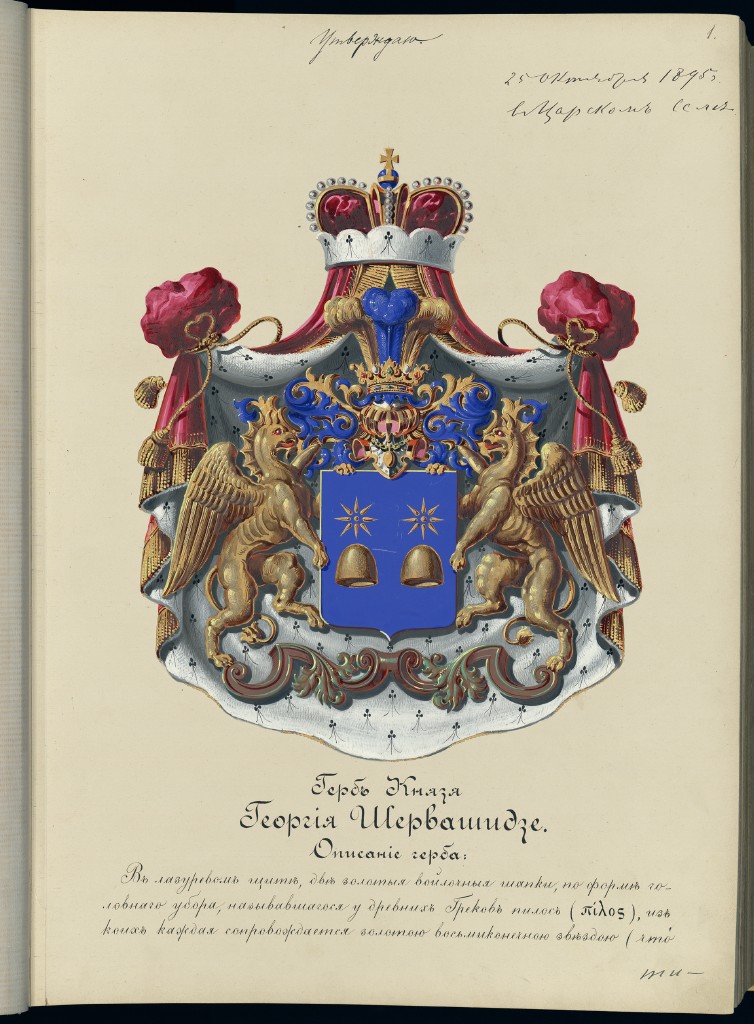
House of Shervashidze (Abkhazian: Чачба, Georgian: შარვაშიძე-შერვაშიძე) was a prominent noble family that ruled Abkhazia from the 12 centurye until the 19 century. Initially, the Shervashidze family governed Abkhazia since 1184 as a duchy within the Kingdom of Georgia. Following the kingdom’s fragmentation in the 15th century, Abkhazia emerged as an autonomous principality and Shervashidze claimed near-sovereign control over it. In the 16th century, Abkhazia fell under Ottoman influence. The most famous ruler from the dynasty was Kelesh Bey Shervashidze (c. 1747–1808) who ruled as a Muslim prince during a period of great turbulence. He is known for centralizing Abkhazia’s administration, fighting against rival Georgian principalities, and navigating between Ottoman and Russian interests. Assassinated by his son, Sefer Ali-Bey, allegedly with Russian support. In 1810, Prince Sefer Ali-Bey Shervashidze aligned with the Russian Empire, resulting in Abkhazia’s incorporation as an autonomous principality within Russia. The family’s rule effectively ended in 1864 when Abkhazia was fully annexed by Russia, and the principality was abolished. Their heraldic symbols were integrated into the Russian noble registry. Shervashidze family known also as Chachba, an Abkhazian local ethnolinguistic variant.
The Shervashidze family’s legacy is evident in various cultural and historical landmarks in Abkhazia. Their history reflects the complex interplay of local traditions and external influences that have shaped Abkhazia over the centuries. The Shervashidze family represent centuries of leadership in a region marked by imperial rivalries, religious shifts (Christianity to Islam and back), and a unique blend of Abkhazian and Georgian traditions. The Y-DNA haplogroup was determined by Big Y testing of the representatives of Shervashidze, Dziapsh-ipa, Emukhvari, Inal-ipa, Caabalırxwa families.
Some links:
https://en.wikipedia.org/wiki/House_of_Sharvashidze
https://gerbovnik.ru/arms/2613.html
https://gerbovnik.ru/og/v16/p0005.jpg
https://upload.wikimedia.org/wikipedia/commons/6/67/Coat_of_Arms_of_the_Sharvashidze.jpg
https://en.wikipedia.org/wiki/Principality_of_Abkhazia

House of Shamkhals

FamilyTreeDNA branch J-BY56385:
https://discover.familytreedna.com/y-dna/J-BY56385/classic
The House of Shamkhals was a medieval dynasty ruling the Shamkhalate, a major historical state located in what is now Dagestan (and, at certain periods, parts of Chechnya, Azerbaijan, and other regions) from the 11th to the 19th centuries. The Shamkhalate’s center was originally at Gazi-Kumukh, later shifting to Tarki. The state reached its greatest power in the 15th–16th centuries, when researchers regard it as the largest and strongest state in the Caucasus, encompassing a number of other political entities. Its rulers held the titles of shamkhal and «Vali of Dagestan.»
The 17th-century German traveler Adam Olearius described a shamkhal who visited him accompanied by two of his brothers and a retinue of fifty mounted men. He was about 36 years old, strong and stout, dressed in a garment of green satin over a coat of mail, with a coarse cloak over that, and armed, like the rest of his company, with a scimitar, bow, and arrows. (Adam Olearius, The Voyages and Travells of the Ambassadors from the Duke of Holstein into Muscovy, Tartary, and Persia, Book VI, 1662 English edition, p. 308.)
Researchers conventionally divide the Shamkhalate’s history into two periods: the Gazi-Kumukh period (before 1641) and the Tarki period (after 1641). The dynasty’s most notable figures include Chupalav-Shamkhal (16th century), Sultan-Mahmud of Endirey (first half of the 17th century), and Surkhay-Shamkhal (1641–1668).
The Y-DNA haplogroup of the Shamkhal dynasty has been determined through Big Y testing of representatives of the dynasty in the Kumyk DNA Project, Lak DNA Project, and Dagestan DNA Project.
Some links:
https://en.wikipedia.org/wiki/Shamkhal_(title)
https://en.wikipedia.org/wiki/Shamkhalate_of_Tarki
https://en.wikipedia.org/wiki/Kumyks
https://en.wikipedia.org/wiki/Kumukh
https://archive.org/details/voyagestravellso00olea/page/308/
Khans of Gazi-Kumukh

FamilyTreeDNA branch J-FTF15779:
https://discover.familytreedna.com/y-dna/J-FTF15779/classic
The Khans of Gazi-Kumukh were one of the most prominent medieval Caucasian dynasties, ruling the Gazi-Kumukh Khanate. By the close of the 16th century, the once-powerful Gazi-Kumukh Shamkhalate had entered a period of decline, weakened by endless succession disputes and outside pressure; by the mid-17th century, the shamkhals’ seat had moved from mountainous Kumukh down to the lowland city of Tarki, leaving highland Lakia, the dynasty’s cradle, in a political vacuum contested by local feudal clans.
It was in this setting that Surkhay-Khan I rose to prominence. The year 1700 is considered the turning point in the birth of the new state: by adopting the title «khan,» Surkhay asserted his independence from the Shamkhalate. Once established, he united the scattered Lak lands into a centralized realm and began a campaign of military expansion, significantly widening the khanate’s borders. Extensive Lezgin and Agul territories came under his rule, including Kurakh and Richa, while his influence also extended into parts of the Dargin and Avar lands. Raiding played an important economic role as well, with campaigns into the wealthy Transcaucasus bringing plunder and rallying the nobility around the throne.
The history of the Gazi-Kumukh Khanate began as a classic case of a strong individual rising amid feudal fragmentation. Surkhay-Khan I became the founder of a new dynasty, and for a century and a half Kumukh grew into one of Dagestan’s key political centers, laying the foundation for a power that would peak under his grandson, Surkhay-Khan II.
The khanate’s capital was the village of Kumukh (Gazi-Kumukh) with population estimated at 50,000–100,000 by the early 19th century, predominantly ethnic Lak, alongside Avar, Dargin, and Lezgin communities. In 1700, the Lak people granted their ruler — previously known by the title «khalklavchi» — the popular title of khan, with a council of elders electing Surkhay-Khan I (1681–1748), son of Garai, as founder of the Gazi-Kumukh Khanate. Its most notable rulers were Surkhay-Khan I «the Conqueror,» Muhammad-Khan (1748–1789), and Surkhay-Khan II «the Just» (1789–1820).
The Y-DNA haplogroup of the Gazi-Kumukh khans has been conclusively established through modern DNA research as originating from within the Lak population, in the Lak DNA Project and Dagestan DNA Project.
Some links:
https://en.wikipedia.org/wiki/Gazikumukh_Khanate
https://en.wikipedia.org/wiki/Gazikumukh_Shamkhalate
https://en.wikipedia.org/wiki/Laks_(Caucasus)
https://en.wikipedia.org/wiki/Kumukh
Daud-Hadji al-Usishi

FamilyTreeDNA Branch J-FTC22925:
https://discover.familytreedna.com/y-dna/J-FTC22925/classic
Daud-Hadji al-Usishi (Dargin: Дауд-ХӀяжи Эфенди; Russian: Дауд-Хаджи Усишинский), also known as Hajj Dawud ibn Muhammad ibn Ali al-Usishi al-Darki, (c. 1686–1757) was a Dagestani scholar, teacher, and Islamic theologian, remembered as one of the leading figures of the 18th-century Arab-Muslim intellectual revival in Dagestan.
Born around 1686 in the village of Usisha (now Akushinsky district, Dagestan), he was the son of a shepherd. He studied first under local scholars, then in Akusha, and finally at the madrasa in Kudutl, where he became a student of the renowned scholar Muhammad al-Kuduki. Daud had an extraordinary memory — he could recite long texts after hearing them just once. On his very first day at the madrasa, he answered a question none of the other students could solve, impressing his teacher instantly. He would later surpass al-Kuduki himself in Arabic philology. Recognizing his gift, al-Kuduki secured his admission to Al-Azhar University in Cairo, where Daud mastered classical Arabic literature, mathematics, logic, astronomy, philosophy, and law, and was later invited to stay on as a teacher. There he wrote a commentary on Arabic grammar still consulted in the Arab world today, with a surviving copy held in a museum in Dagestan.
On his return, his fellow villagers called him back to Usisha, built him a house and made him their qadi. His standing in the village was such that he once refused to let it pay tribute to the Iranian shah. His most notable written work, «Hashiya al-Charpardi» (1730–31), became one of the most widely used Arabic textbooks in Dagestani madrasas throughout the 18th century, alongside his commentaries on logic and Islamic jurisprudence.
He died in Usisha in 1757; a manuscript preserved in the village’s mosque fixes the date precisely — the 9th of Muharram, 1171 AH, or September 23, 1757. His detailed Y-DNA haplogroup was determined by Big Y testing of the direct male descendant in the Dargwa DNA Project.
Some links:
https://www.gazavat.ru/history/14/917/
https://blog.welcomedagestan.ru/dagestan/akushinskij/usisha/znamenityj-rod-dauda-iz-usisha/
https://ru.wikipedia.org/wiki/%D0%94%D0%B0%D1%83%D0%B4-%D0%A5%D0%B0%D0%B4%D0%B6%D0%B8_%D0%B0%D0%BB-%D0%A3%D1%81%D0%B8%D1%88%D0%B8
https://www.dissercat.com/content/daud-khadzhzhi-al-usishi-zhizn-i-tvorcheskoe-nasledie
https://islamology.ru/content/%D0%B0%D0%BB-%D1%83%D1%81%D0%B8%D1%88%D0%B8/
Khabib Nurmagomedov

FamilyTreeDNA Branch J-FT27388:
https://discover.familytreedna.com/y-dna/J-FT27388/classic
Khabib Abdulmanapovich Nurmagomedov, nicknamed «The Eagle, is a Russian former professional mixed martial artist of Avar descent from Dagestan, widely regarded as one of the greatest mixed martial artists in UFC history and ranked #1 pound-for-pound at the time of his retirement.
Born in the village of Sildi in the Tsumadinsky District of Dagestan, he began wrestling at age eight under his father, Abdulmanap, a decorated sambo and judo coach. His family later moved to Makhachkala, where he continued training in wrestling, judo, and combat sambo, becoming a two-time Combat Sambo World Champion.
Nurmagomedov made his UFC debut in 2012, at age 23, and went on to become the longest-reigning UFC Lightweight Champion, holding the title from 2018 to 2021 and defending it three times, including a decisive submission win over Conor McGregor at UFC 229. Following his father’s death in 2020, he retired later that year with a perfect 29–0 record, having promised his mother it would be his last fight. He was inducted into the UFC Hall of Fame in 2022. He is recognized as the first Muslim UFC champion and, true to his Avar heritage, was often seen wearing a traditional papakha hat after fights and at public appearances.
His detailed Y-DNA haplogroup was determined by Big Y testing of close patrilineal relatives in the Chechen DNA Project and Dagestan DNA Project.
Pictured: Khabib Nurmagomedov submitting Conor McGregor at UFC 229 (2018).
Some links:
https://www.ufc.com/athlete/khabib-nurmagomedov
https://en.wikipedia.org/wiki/Khabib_Nurmagomedov
http://ufcstats.com/fighter-details/032cc3922d871c7f
https://www.championat.com/boxing/article-4166333-habib-nurmagomedov—konor-makgregor-uslovija-provedenija-boja-revansha-v-ufc.html
Islam Makhachev

FamilyTreeDNA Branch J-FTG67334:
https://discover.familytreedna.com/y-dna/J-FTG67334/classic
Islam Ramazanovich Makhachev is a Russian professional mixed martial artist, an ethnic Lak from Dagestan, and, as of 2026, the reigning UFC Welterweight Champion and former UFC Lightweight Champion — the eleventh two-division champion in UFC history and #1 in the pound-for-pound rankings.
Born in Makhachkala and raised in the village of Burshi, he began training in taekwondo at age seven before switching to combat sports under Abdulmanap Nurmagomedov, having grown up alongside Khabib Nurmagomedov and their circle of training partners in the same Dagestani sambo system. He became a combat sambo world champion in 2016 and a two-time Russian national champion at 74 kg.
He made his UFC debut in 2015, at age 23, and went on to capture the vacant UFC Lightweight Championship in 2022, defending it four times before moving up to welterweight and defeating Jack Della Maddalena at UFC 322 in 2025 to win a second title, tying Anderson Silva’s record 16-fight UFC winning streak. He holds numerous lightweight-division records, including the most title defenses and the highest significant-strike accuracy in division history.
His detailed Y-DNA haplogroup was determined by Big Y testing of a close patrilineal relative in the Lak DNA Project.
Pictured: Islam Makhachev after defeating Jack Della Maddalena at UFC 322 (2025).
Some links:
https://en.wikipedia.org/wiki/Islam_Makhachev
https://www.ufc.com/athlete/islam-makhachev
https://www.nytimes.com/athletic/6811386/2025/11/16/ufc-322-islam-makhachev-welterweight-champion/
Kaytmaz Avarsky

FamilyTreeDNA Branch J-BY44738:
https://discover.familytreedna.com/y-dna/J-BY44738/classic
Kaytmaz Rashidudinovich Avarsky (born 15 January 1957) is a Dagestani art scholar and ceramicist known for his research into the ancient pottery traditions of the Caucasus and the Russian Far East.
He graduated with honors from the art and graphic design faculty of the Dagestan State Pedagogical Institute in 1982 and completed his postgraduate studies at the Tbilisi Academy of Arts in 1990. His ceramic work draws on archaic decorative techniques — burnishing, applied ornament, and incised petroglyph-like patterns — favoring the natural tones of fired clay or smoked black and gray finishes. He has long pursued the revival of these ancient pottery techniques, aiming to make them accessible to the broader public — especially children and young people — through reproduction as cultural artifacts and decorative objects.
He is a descendant of Gebek, brother of Umma-Khan VI the Great, ruler of the Avar Khanate, and traces his family’s origins back to the medieval Avar nutsals descended from Surakat, the influential 13th-century ruler of the pre-Islamic Avar state of Sarir, whose domain reportedly extended from Shemakha to Kabarda — a scope of rule corroborated by medieval Arab geographers, who placed Sarir between Alania and Derbent. Umma-Khan VI the Great (1761–1801), son of Muhammad-Nutsal IV and Bakhu, daughter of Khan-Muhammad of Kaytag, ruled the Avar Khanate from age twelve until his death and expanded its borders by subduing the free Avar societies and neighboring territories alike. Tribute was paid to him by Georgia’s King Erekle II, and by the khans of Derbent, Kuba, Baku, Shirvan, and Sheki, as well as by the pasha of Akhaltsikhe; he further imposed tribute on the Karabakh Khanate and Tushetia.
His detailed Y-DNA haplogroup was determined by Big Y testing of a direct male descendant in the Avar DNA Project.
Some links:
https://www.slovoart.ru/node/1926
https://ru.wikipedia.org/wiki/%D0%A3%D0%BC%D0%BC%D0%B0-%D1%85%D0%B0%D0%BD_VI
Ali Kayayev

FamilyTreeDNA Branch J-FTH74863:
https://discover.familytreedna.com/y-dna/J-FTH74863/classic
Ali Kayayev (Lak: Аьли Къаяхъал) also known as ʿAlī ibn ‘Abd al-Ḥamīd al-Ghumūqī (c. 1878–1943), was a Dagestani Islamic theologian, historian, and qadi, remembered as one of the leading educators and scholars of Dagestan in the late 19th and early 20th centuries, and one of the principal figures of the Jadid reform movement in the North Caucasus.
Born in the Lak village of Gazi-Kumukh into an aristocratic family, he studied under several sheikhs before travelling to Astrakhan, where he developed an interest in academia. In 1905 he left Astrakhan for Cairo, then part of the Ottoman Khedivate of Egypt, to further his studies at Al-Azhar University from 1905 to 1907, becoming acquainted with Islamic modernism. In 1908 he moved to Constantinople but was arrested for his support of the Young Turk Revolution and returned to Dagestan.
On his return, he opened reformist madrasas in Temir-Khan-Shura (modern Buynaksk) and Gazi-Kumukh, introducing secular subjects like mathematics and astronomy alongside traditional Islamic law, drawing students from across the North Caucasus and educating a generation of future Dagestani intellectuals and Soviet officials. From 1913 he edited the newspaper Jaridat Daghistan, which despite the Russian government’s intentions became an organ for Muslim intellectuals as far west as Circassia.
He supported the Russian Revolution, like most Dagestani Muslims, and after the short-lived Mountainous Republic of the Northern Caucasus gained independence from Russia, he was elected to its Regional Committee. He withdrew from politics with the onset of civil war, serving instead as qadi of Gazi-Kumukh’s sharia court.
He was arrested in 1930 and exiled to the Urals, then re-arrested in 1938 over his ties to purged former student Dzhelal Korkmasov and exiled to Kazakhstan, where he continued writing on scraps of paper until his death from typhus on 21 December 1943. He was posthumously rehabilitated in the 1960s. His extensive body of work — spanning astronomy, geography, philosophy, linguistics, and history — was written in Arabic, Lak, and Turkic, and remains only partially collected and studied.
His detailed Y-DNA haplogroup was determined by Big Y testing of a direct male descendant in the Lak DNA Project.
Some links:
https://en.wikipedia.org/wiki/Ali_al-Ghumuqi
https://dagpravda.ru/obshestvo/ali-kayaev-zamir-ali/
https://islamology.ru/content/%D0%BA%D0%B0%D1%8F%D0%B5%D0%B2-%D0%B0%D0%BB%D0%B8/
https://imenakavkaza.ru/biographii/ali_kayaev/
Mirza Hasan Alkadari

FamilyTreeDNA Branch J-FTH48188:
https://discover.familytreedna.com/y-dna/J-FTH48188/classic
Mirza Hasan Alkadari (Lezgian: Хьасан Абдуллагьан хва Алкьвадарви; c. 1834 – 1910) was a North Caucasian Islamic jurist, historian, poet, and educator of ethnic Lezgin origin, best known as the author of «Kitāb Āthār-i Dāghistān» («Historical Information about Dagestan»), which covered the history of the peoples of Dagestan for many centuries.
Born in Balakhani to a family that had relocated there from Alkadar, he was the son of Hajji Abdullah, a noted scholar of grammar, logic, the Quran, and hadith studies, and a student of the Naqshbandi Sufi master Muhammad Yaraghi. Hasan later studied in Akhty under Mirza Ali al-Akhti, mastering Arabic, Turkic, and Persian and studying Islamic law alongside classical works on astronomy and philosophy. He went on to serve as secretary to Yusuf Khan, ruler of Kura, a member of the district court, and naib of South Tabasaran, rising steadily through the ranks of the Russian imperial civil service to lieutenant by 1874 — a rank that, under imperial law, conferred personal nobility.
Implicated in the 1877 uprising in Dagestan and Chechnya, Alkadari was imprisoned and exiled to Spassk in Tambov Governorate in 1879, where he formed close ties with the local Tatar Muslim community. He returned home in 1883 under an amnesty granted by Alexander III, opening a school in his native village to teach reading, arithmetic, geography, astronomy, and Dagestani history.
Alkadari wrote in classical Arabic, Turkic, and Persian, also contributing to the Baku newspaper Akinchi and the Tbilisi-based Ziya. Beyond «Kitāb Āthār-i Dāghistān,» his major works include «Jirab al-Mamnun» (1912), a treatise on Shafi’i Islamic law, and «Divan al-Mamnun» (1913), a poetry collection recounting the events of 1877.
His detailed Y-DNA haplogroup was determined by Big Y testing of a direct male descendant in the Caucasian Albania DNA Project and Dagestan DNA Project.
Some links:
https://en.wikipedia.org/wiki/Mirza_Hasan_Alkadari
https://rusneb.ru/catalog/000199_000009_008733632/
https://alkadar.ru/index.php/zaly/zal-1-gasan-alkadari
https://suleiman-stalskiy.ru/o-rayone/personalii/deyateli-nauki/gasan-efendi-alkadarskiy/
https://www.isaran.ru/?q=ru/fund&guid=12D17712-3DC9-4C49-8C8D-CEBB49431226&ida=35
Hajji-Ayyub al-Akushi

FamilyTreeDNA Branch J-FTH49744:
https://discover.familytreedna.com/y-dna/J-FTH49744/classic
Hajji-Ayyub al-Akushi (Dargin: ХӀяжи-Аюб Кьади) was a sheikh, military leader, and supreme judge who took part in the anti-Persian resistance against Nadir Shah. He was elected qadi of Akusha-Dargo, a historical confederation of free societies in Dagestan, serving in that role from the 1730s until his death.
He also served for a time as qadi of Shamakhi under the Gazi-Kumukh khan Surkhay. During Nadir Shah’s first Dagestani campaign, Dagestan’s rulers stood divided, leaving Surkhay to face the invasion alone; defeated, he retreated to Avaria as the shah took Kumukh. Anticipating a continued advance, Hajji-Ayyub coordinated a joint defense with neighboring qadis. As Persian pressure mounted, he swore allegiance to Russia’s General Levashov in 1735, then ruling over some 30 villages. When Nadir Shah returned that same year on a second campaign through Akusha, Hajji-Ayyub outwardly submitted while secretly siding with Surkhay — a defiance the shah punished by devastating Dargin villages.
Hajji-Ayyub held wide authority among Dagestan’s peoples and used his standing to rally other rulers against the Persian army, serving as spiritual mentor to both Utsmi Ahmad-Khan and Shamkhal Hasbulat. When a weakened Nadir Shah later proposed an alliance against Russia, Hajji-Ayyub warned the Akusha elders that any move against the Russians would only unite Dagestan’s factions with Russia against the shah instead.
His detailed Y-DNA haplogroup was determined by Big Y testing of a direct male descendant in the Dargwa DNA Project and Dagestan DNA Project.
Some links:
https://ru.wikipedia.org/wiki/%D0%A5%D0%B0%D0%B4%D0%B6%D0%B8-%D0%90%D0%B9%D1%8E%D0%B1_(%D0%BA%D0%B0%D0%B4%D0%B8%D0%B9)
https://www.mekegi.com/history/akusha_dargo/
https://ru.wikipedia.org/wiki/%D0%90%D0%BA%D1%83%D1%88%D0%B0-%D0%94%D0%B0%D1%80%D0%B3%D0%BE